

Aurelio Amendola
"Masterpieces Photographed"
Aurelio Amendola exhibits again at Palazzo Reale in Milan thirty years after his solo exhibition Cappelle Medicee (1995): from June 16th to September 6th, 2026, the rooms of the palace will host the exhibition Aurelio Amendola. Capolavori fotografati. Burri, Vedova, Nitsch, Duomo di Milano, Bernini, Canova, Michelangelo, an exhibition promoted by the Municipality of Milan – Culture, produced by Palazzo Reale, in collaboration with the Associazione Culturale BUILDING. Through 85 large-format photographs, taken between 1976 and 2025, the exhibition celebrates the most emblematic aspects of the work of Amendola (Pistoia, 1938), a central figure in the field of contemporary art photography, who stands out for his ability to navigate art history and transform light into narrative with a sensitive and intense gaze.
At the heart of the exhibition is the dialogue that the photographer has managed to establish, through his camera’s lens, with some of the greatest figures in the history of art. From the immortal sculptures of Michelangelo Buonarroti (1475–1564), Gian Lorenzo Bernini (1598–1680), and Antonio Canova (1757–1822), to the expressive power of the contemporaneity—represented by Alberto Burri (1915–1995), Emilio Vedova (1919–2006), and Hermann Nitsch (1938–2022)—his images reveal as much the secret life of the artworks as the artists’ deepest identities. This exploration is accompanied by a section dedicated to the Duomo di Milano, featuring a series of previously unpublished photographs that examine the cathedral as a plastic body and sculpted matter: not merely architecture, but a true sculpture traversed by light and time.
Presenting itself as a journey that connects different artistic practices and historical periods, “Aurelio Amendola. Capolavori fotografati” constructs a powerful and layered visual narrative that reinterprets art history from an intimate and personal perspective, questioning matter, gesture, and memory.
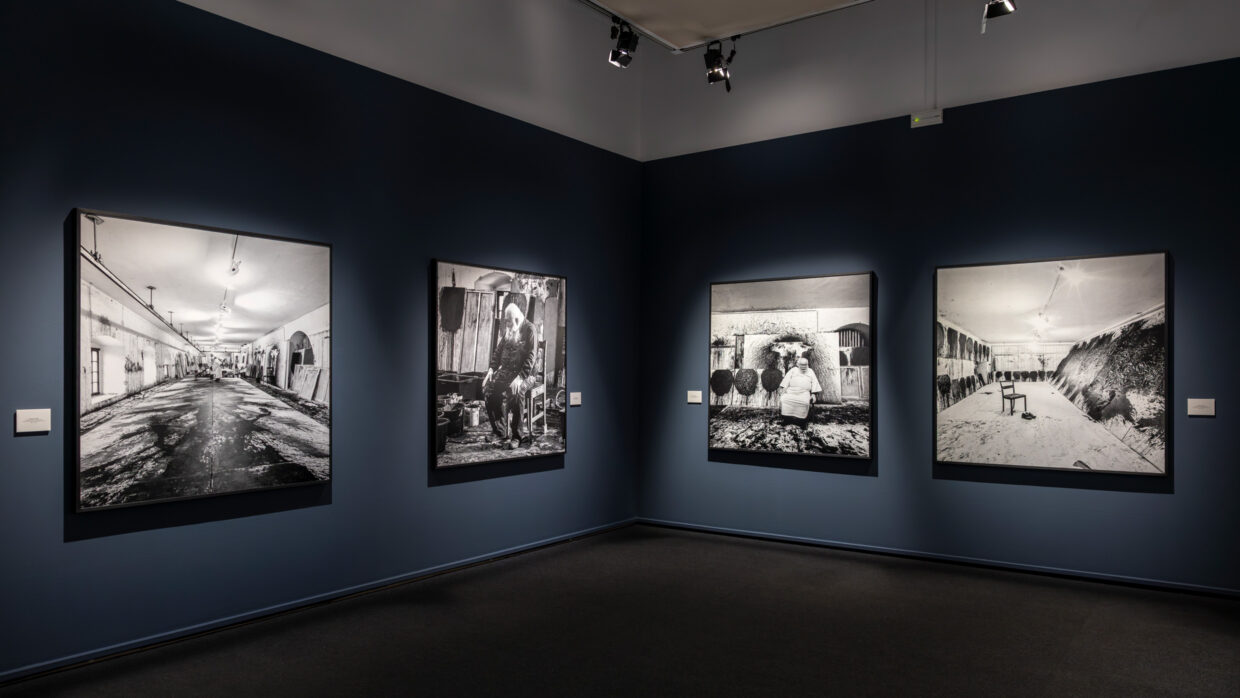
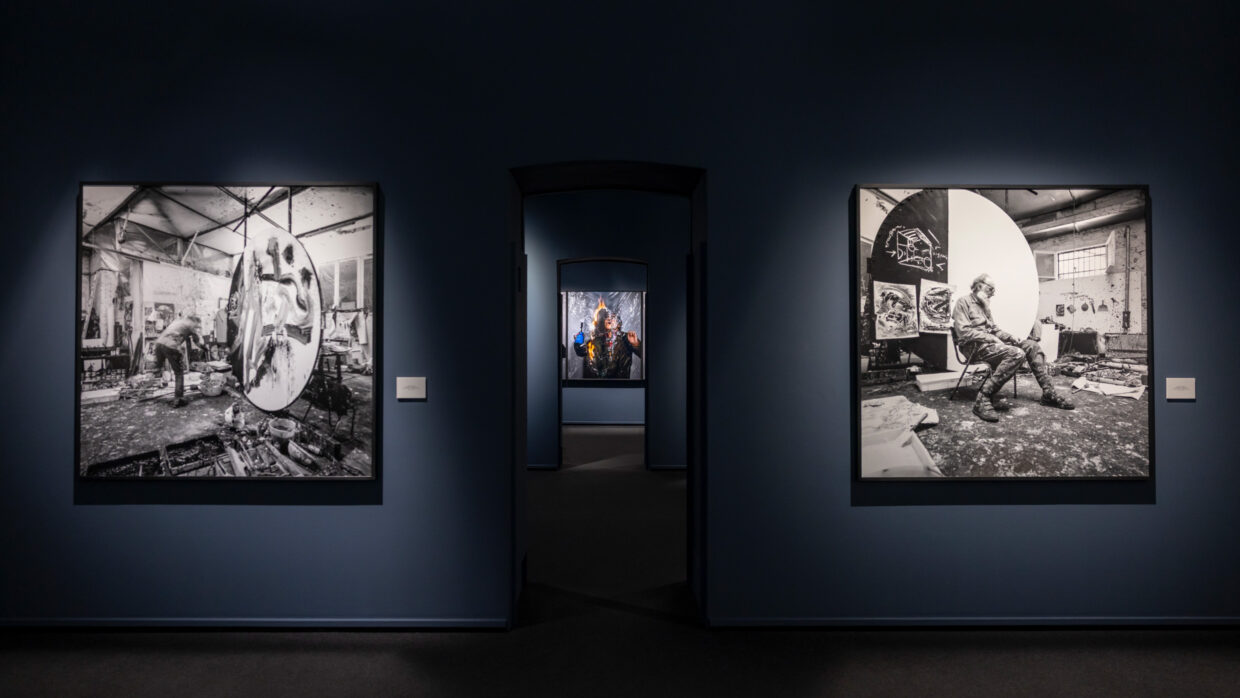
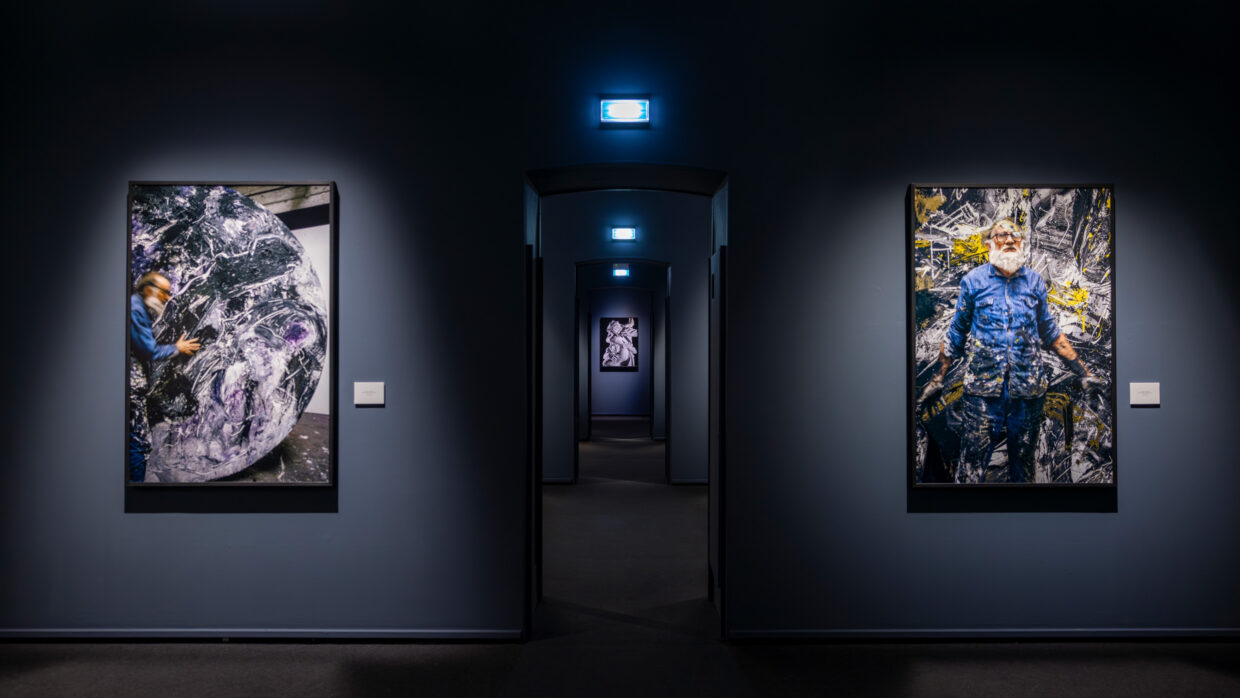
The exhibition opens with an initial group of 41 photographs—brought together here also thanks to loans from prestigious Italian and international collections, such as the Fondazione Palazzo Albizzini Collezione Burri in Città di Castello, the Fondazione Emilio e Annabianca Vedova in Venice, and the Nitsch Foundation in Vienna—dedicated to three major figures of the late 20th century whose artistic practice is deeply rooted in action: Hermann Nitsch, Alberto Burri, and Emilio Vedova. In their works, the gesture becomes a sign, matter, energy, and then a work of art: a visible trace of the creative act. Amendola portrays them in their respective studios, capturing their most intimate and, at the same time, dynamic dimension, conveying the power and intensity of their art through the images.
Among the artworks presented, a selection of photographs illustrates the “blood-red actions” performed by Hermann Nitsch at Prinzendorf Castle in 2012, condensing the essence of his practice into a more intimate and previously unseen narrative compared to the performative and choral dimension that characterizes his actions.
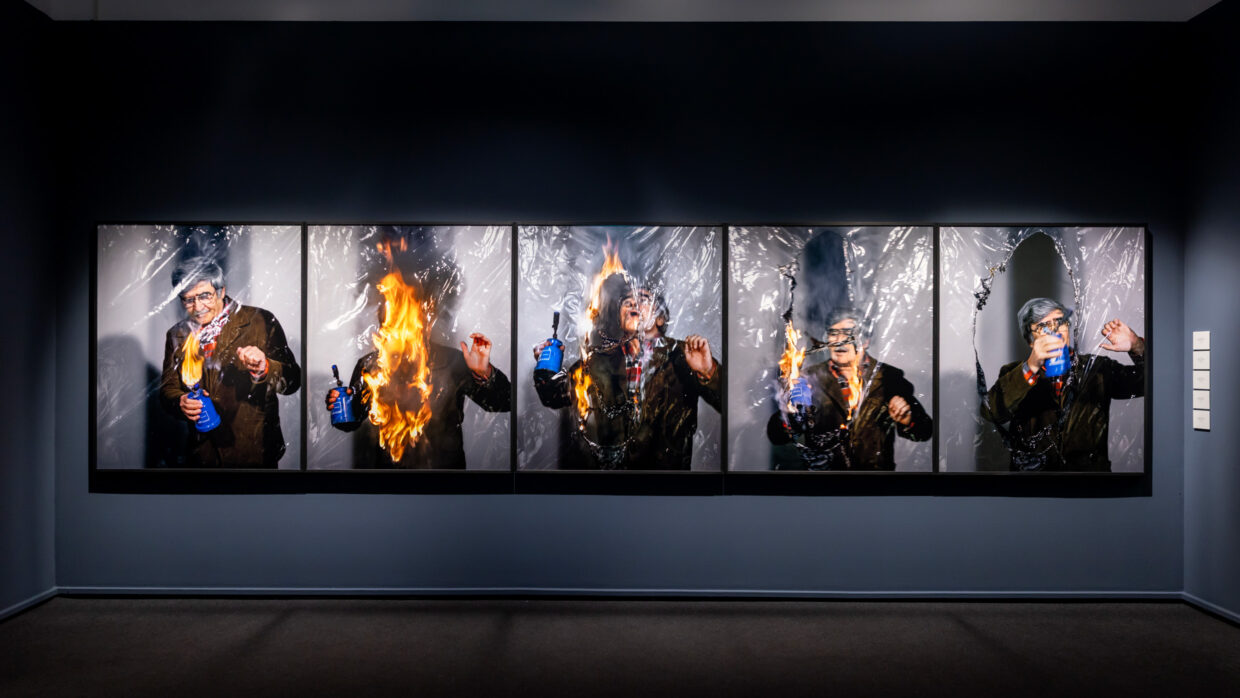
Of particular importance are Alberto Burri’s famous Combustioni: in 1976, in Città di Castello, Amendola created a photographic sequence in which the artist is captured in the act of burning a plastic surface, altering the material. In these images, a creative process emerges clearly, in which the gesture—both mechanical and spontaneous—gives form to some of his most iconic works.
In the 1987 photographs dedicated to Emilio Vedova, instead, the generative vortex of his art emerges. The energy that runs through the works—particularly the large circular paintings—manifests itself as a direct extension of tense, nervous, yet controlled gestures: Vedova is captured as he moves through the space of the studio as if it were a battlefield, and his body becomes the matrix of the pictorial sign.
The exhibition continues with a room entirely dedicated to 9 photographs of the Duomo di Milano (2009), shown to the public for the first time. Through details, perspectives, and the play of light, the cathedral is reinterpreted in all its formal complexity and expressive power. In the context of Palazzo Reale and its physical proximity to the Duomo, the presence of these photographs takes on a particularly evocative significance, reinforcing the dialogue between image and place, representation and presence.
The exhibition concludes with 35 photographs depicting some of the most famous sculptural masterpieces by great Italian masters of the past: Gian Lorenzo Bernini, Antonio Canova, and Michelangelo Buonarroti.
Through elegant plays of light that emphasise the marble surface, Amendola’s black-and-white photographs highlight perspectives and details, offering fresh perspectives on the various sculptural groups: from the drama of Bernini’s Ratto di Proserpina (1621–1622) by Bernini, to the tenderness of time suspended in the embrace between Amore e Psiche (1787–1793) by Canova, to the profound gaze of the statue of Giuliano de’ Medici, created by Michelangelo for the Cappelle Medicee of the Sagrestia Nuova in Florence (1521–1534). The marble preserves the traces of the sculptor’s intervention, revealing itself as a living, vibrant substance. The surface, animated by the play of light and chiaroscuro, is further reinterpreted by the photographer’s gaze, which brings out a new intensity.
A bilingual (Italian and English) catalog published by Skira will be released in conjunction with the exhibition, presenting Aurelio Amendola’s work through a selection of the pieces on display at Palazzo Reale.
Biography of the photographer:
Born in Pistoia in 1938, Aurelio Amendola is one of Italy’s most important art photographers. Throughout his career, he has focused on contemporary art, creating portraits of the great masters of the 20th century, such as Giorgio de Chirico, Arnaldo Pomodoro, Mario Schifano, Roy Lichtenstein, and Andy Warhol. Thanks to his direct relationships with artists such as Giacomo Manzù, Agenore Fabbri, Mario Ceroli, Giuliano Vangi, Jannis Kounellis, Michelangelo Pistoletto, Claudio Parmiggiani, and Mimmo Paladino, he has produced numerous photographic monographs accompanied by his own photographs. His collaborations with Marino Marini and Alberto Burri were particularly significant. At the same time, he pursued research focused on Renaissance and classical sculpture, photographing works by Donatello, Jacopo della Quercia, Luca della Robbia, Antonio Canova, Gian Lorenzo Bernini, and above all Michelangelo Buonarroti, to whom he dedicated catalogs, exhibitions, and monographs. His approach is distinguished by an emotional and sensory vision, far beyond simple documentation.
Among his early works, Il pulpito di Giovanni Pisano a Pistoia (1969) stands out, the result of an extensive photographic project that began in 1964. In 1994, he published Un occhio su Michelangelo, dedicated to the Medici Chapels of San Lorenzo in Florence, winning the Oscar Goldoni Award for best photography book of the year. He also produced important volumes on St. Peter’s Basilica, interpreted through previously unseen perspectives and details.
Over the years, Aurelio Amendola has experimented with constant cross-contamination between the ancient and the contemporary, through bold choices, juxtapositions, and visual interweavings that lend the contemporary a classical framework and the ancient a modern sensibility. The result is timeless images and photographic sequences, dedicated as much to portraiture and statuary as to symbolic sites such as Milan Cathedral, Matera, San Galgano, the park of the Gori-Fattoria Celle Collection, the Vittoriale degli Italiani, and Burri’s Cretto. Scholars and critics such as Antonio Paolucci, Tomaso Montanari, Maurizio Calvesi, Bruno Corà, and Vincenzo Trione have written about his work. His works are part of major public and private collections, including the Maramotti Foundation, GAM Turin, the Arnaldo Pomodoro Foundation, MAXXI, the Alberto Burri Foundation, and the Uffizi Gallery.
Among his major exhibitions: Cappelle Medicee at the Palazzo Reale in Milan (1995), Michelangelo Scultore at the Hermitage Museum (2007), and In Atelier fotografie dal 1970-2014 at the Triennale di Milano (2014). He has received numerous awards, including the “Cino da Pistoia” Prize (1997), “Il Micco” (2012), an honorary academic degree, and the title of Accademico d’Italia (2014). In 2009, he was received by Pope Benedict XVI in the Sistine Chapel. In 2021, Pistoia dedicated the exhibition Un’Antologia to him, followed in 2022 by an exhibition at the Castello Svevo in Bari. In the same year, the Museo dell’Opera del Duomo inaugurated the exhibition Lo sguardo di Aurelio Amendola fra naturalismo e astrazione. In 2023, the Holden Luntz Gallery exhibited works dedicated to Michelangelo, Canova, and Bernini, while the exhibition Amendola Burri Vedova Nitsch azioni e gesti was presented at the Fondazione Palazzo Albizzini Collezione Burri and subsequently at the Fondazione Emilio e Annabianca Vedova. In 2024, Amendola was honored at Teatro alla Scala. In 2025, the Gypsotheca Antonio Canova acquires several of his artworks thanks to the “Strategia Fotografia 2024” project. In 2025, at the MIA Photo Fair BNP Paribas, he presents a selection of photographic portraits of contemporary artists, and, at the same time, the exhibition Aurelio Amendola at BUILDING explores the photographer’s dialogue with the works of Michelangelo Buonarroti, Antonio Canova, and Gian Lorenzo Bernini.
Text provided by:
ddl |arts|
Photo credits:
Installation view, “Aurelio Amendola. Capolavori fotografati”, Palazzo Reale, Milano, photographer: Rebecca Amendola