

Hermann Nitsch: Azione e Pensiero
curated by Marzia Capannolo in cooperation with Galleria Umberto Benappi
For Fall/Winter 2026, La Crescentina – Laboratorio per l’Arte, located in the Monferrato countryside in the province of Alessandria, presents the exhibition Hermann Nitsch: Action and Thought, dedicated to one of the founding fathers of Viennese Actionism, who transformed art into a visceral and all-encompassing experience, transcending the traditional concept of representation to establish a rite of collective liberation. The exhibition, which opens to the public on 27 September 2026, until 10 January 2027, is curated by Marzia Capannolo, with critical contributions from Lóránd Hegyi, and produced in collaboration with Galleria Umberto Benappi in Turin.
Hermann Nitsch has placed the Theater of Orgies and Mysteries at the center of his research, a total work of art in which the audience ceases to be spectators and becomes an active participant in a secular liturgy. Through the symbolic and material use of blood, flesh, and color, the artist fuses the memory of Dionysian myths, Christian sacrifice, and psychoanalytic catharsis in a primordial celebration of life and death. His celebrated Schüttbilder—paintings created by pouring and spreading red pigment onto canvas—transform from chromatic surfaces into tangible relics of a sacred act. This aesthetic of excess and the sacred translates into a sensorial and synesthetic assault, where the act of painting dialogues with music, food, and the body, awakening modern man from bourgeois torpor. More than a provocation, Nitsch’s work presents a profound, visceral reconnection with the lifeblood and spirituality of the earth.
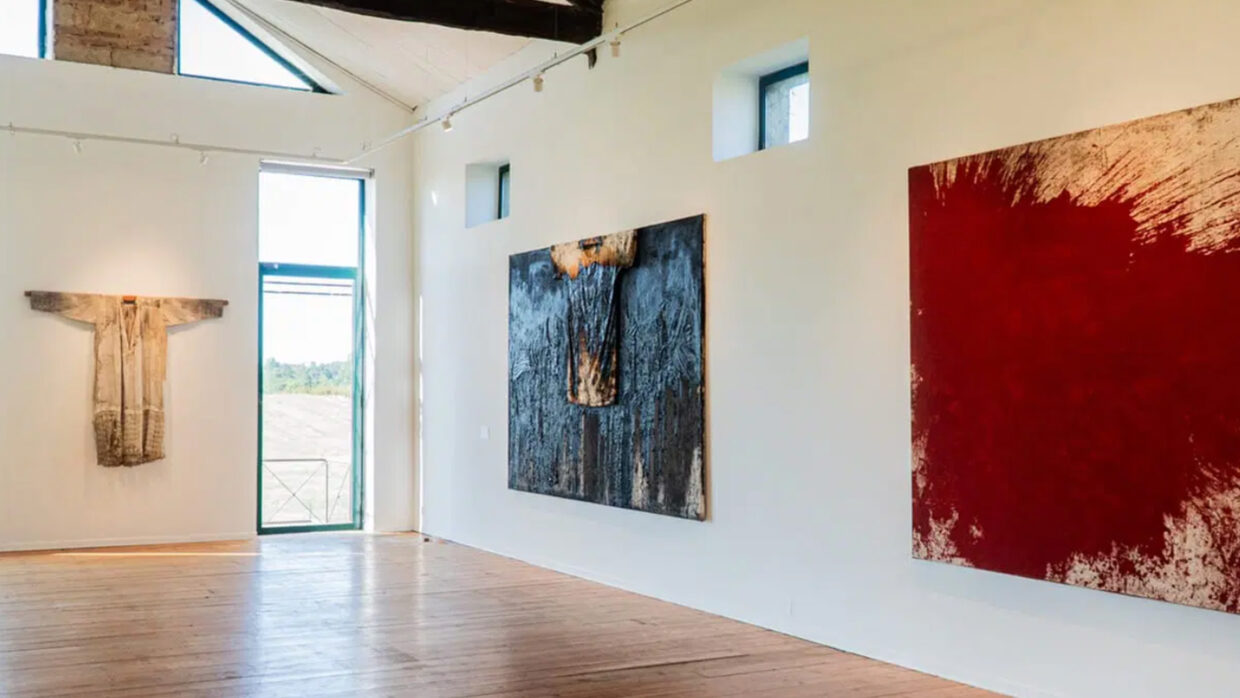
The exhibition brings together approximately twenty works, including large canvases, works on paper, and a ritual tunic from 1973 (Chorhemd aus der 41. Aktion, Prinzendorf), enriched by a collection of historical photographs taken by Fabrizio Garghetti during the artist’s celebrated performative actions, providing visual evidence of the genesis of the ritual. The exhibition focuses on the Austrian master’s purely pictorial and chromatic dimension. The tunic, a direct testimony and relic of the sacred action, serves as a conceptual hinge: on it, the blood trail becomes a primordial visual substance, marking the genesis of Nitsch’s visual language. This is accompanied by two imposing canvases on display, Pittura dell’Orgien Mysterien Theater from 1984 and Schüttbild from 1997 (both three meters wide), in which the performative urgency gives way to the architecture of color and the monumentality of gestural application. Emblematic of the artist’s pictorial maturity is the canvas Untitled from 2002, in which the dense impasto of dark green and blood red, worked directly onto the surface by hand, testifies to the transmutation of rhythmic gesture into a profound, almost sculptural, pictorial meditation.
A central role is also given to the works on paper, in which the act of pouring and spreading pigment acquires an extraordinary expressive immediacy. Among the most representative works on paper is Untitled from 2007 (acrylic on canvas-backed paper, 100 x 212 cm), a monumental chromatic horizon in which blues, greens, yellows, and reds blend in a cosmic and primordial turbulence; This is counterpointed by the 2002 Schüttbild auf Papier (oil on paper, 100 x 122 cm), where the frontal impact of the bright red flow interacts with the transparency of the background, revealing a refined sensitivity in the articulation between material density, light, and pictorial application.
The exhibition Hermann Nitsch: Action and Thought also suggests a dialogue between the artist’s legacy and the telluric power of the clayey folds of Monferrato. The exhibition highlights a chromatic and spiritual overlap between the liturgical red of Viennese Actionism and the brown hues, calcareous marl, and ferrous sediments of the hills surrounding La Crescentina, a territory that is a point of passage, the result of a millennia-long metamorphosis due to a complex stratification of clay, silt, and limestone that gives the soil and sedimentary rocks of the area their characteristic and evocative gray-blue hue. Nitsch, who frequented these lands and recognized the echoes of his primordial research, is celebrated through the concept of vital matter, finding in La Crescentina the secular altar for his art.
The exhibition is organized with the contribution of Cassa di Risparmio di Alessandria and with the patronage of: Municipality of Fubine Monferrato; Langhe Roero Monferrato Wine Landscapes Institute; Austrian Cultural Forum of Milan
Text @ La Crescentina