

The Last Supper
exhibition on the sensual intensity of cult and ritual processes
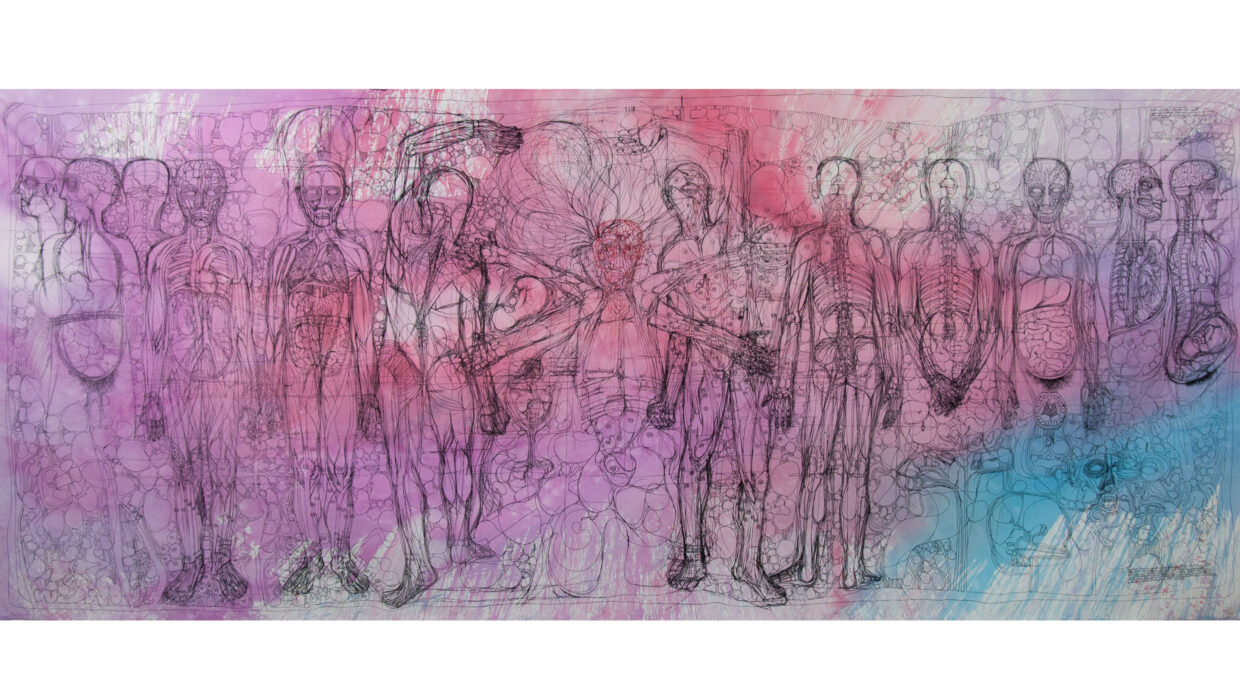
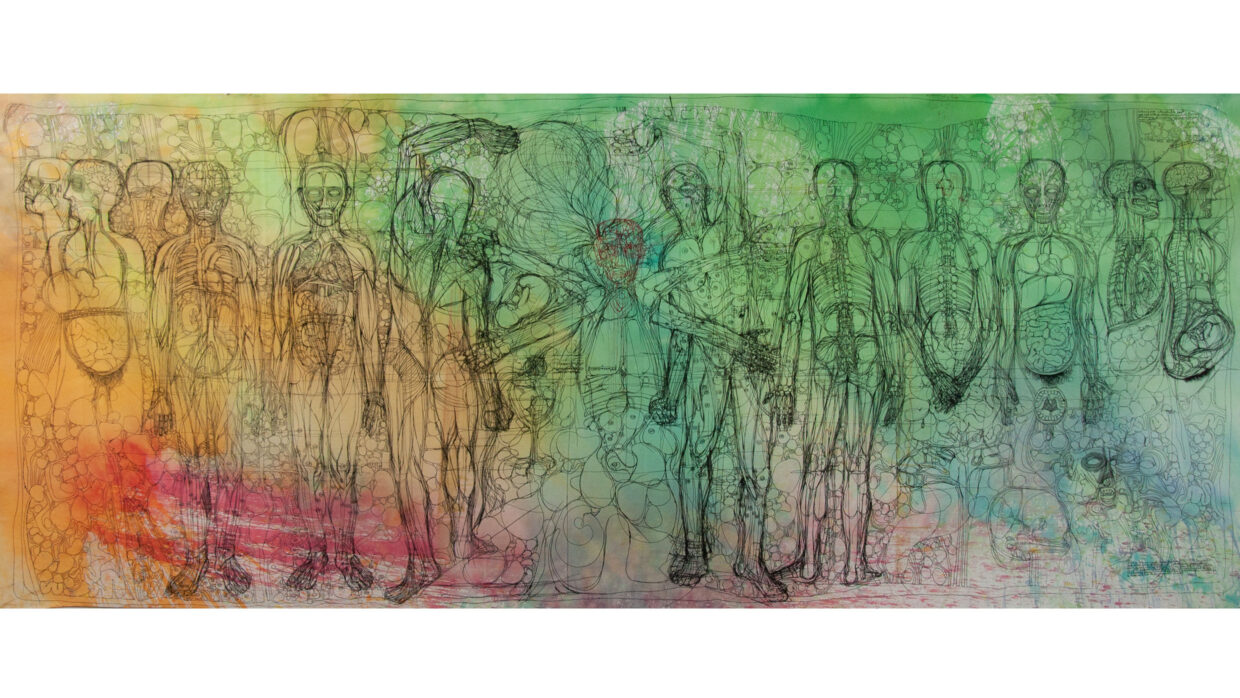
In its new exhibition, ‘The Last Supper,’ the Nitsch Foundation focuses on a major graphic work by Hermann Nitsch. In it, he uses familiar Christian iconography to approach a central motif of his Orgien Mysterien Theater (Mysteries of the Orgies Theatre) through the theme of the Eucharist: the intense experience of being.
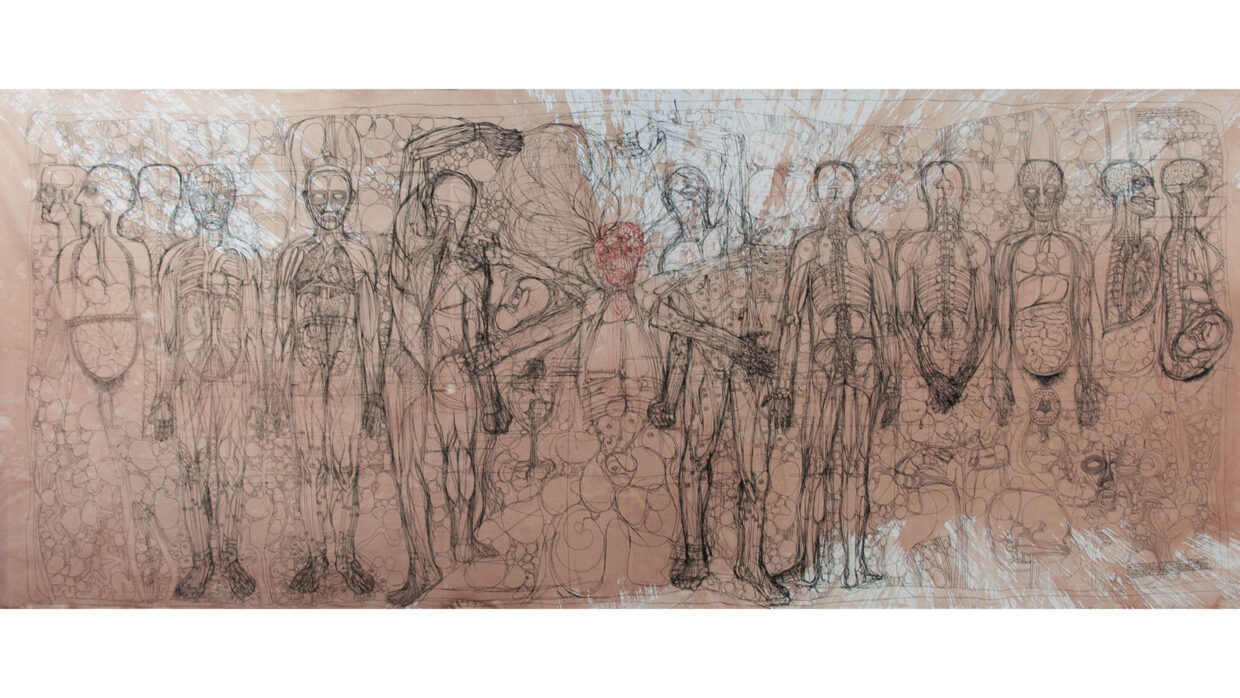
In the mid-1960s, inspired by the work of Walter Pichler, Hans Hollein and Raimund Abraham, Hermann Nitsch began to produce architectural sketches. Since he could not appreciate contemporary architecture, his buildings were to be constructed below the earth’s surface, formally winding their way into the earth-like entrails. He began to design an underground theatre complex consisting of vegetatively winding corridors, caves and chambers for all those actions of the 6-day play that did not take place outdoors or in the rooms of Prinzendorf Castle. The ‘natural phenomenon of man’ became the model for his architectural designs. The sensuality of the outward-turned innermost self as a motif of the Orgien Mysterien Theater is reflected in organic kidney and liver shapes and winding intestinal passages. He described drawings such as ‘The Last Supper’ or ‘The Entombment’ as ‘architectural drawings based on representational models’.
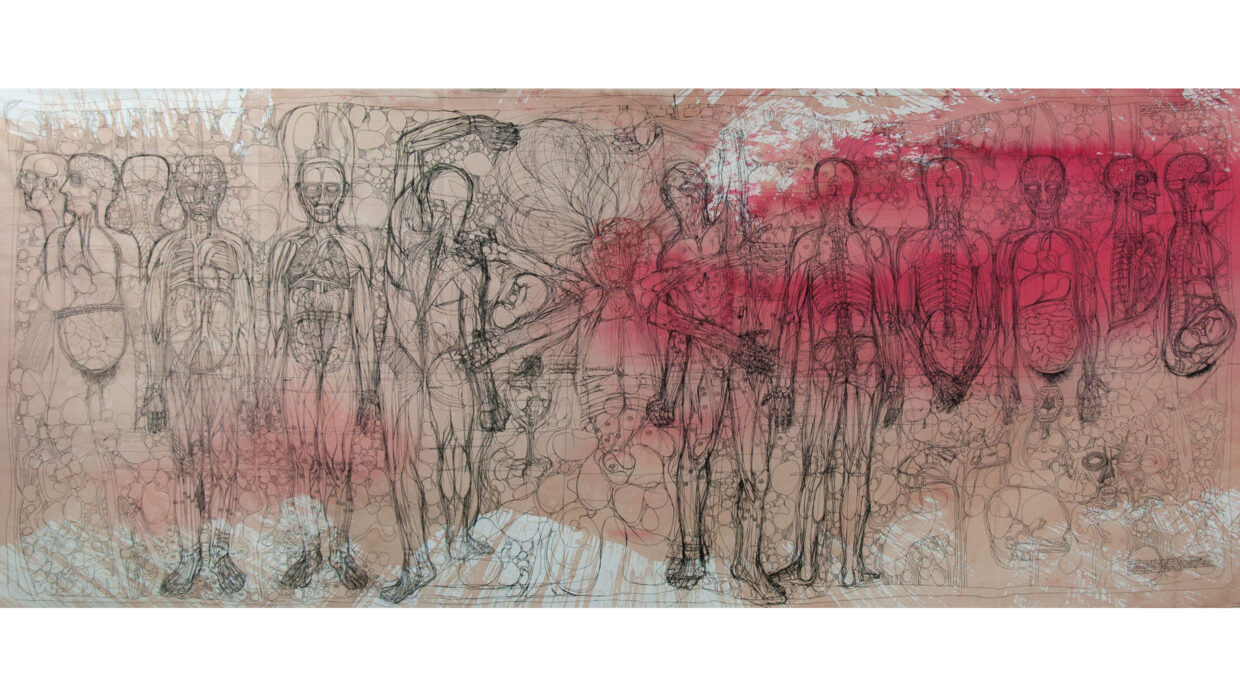
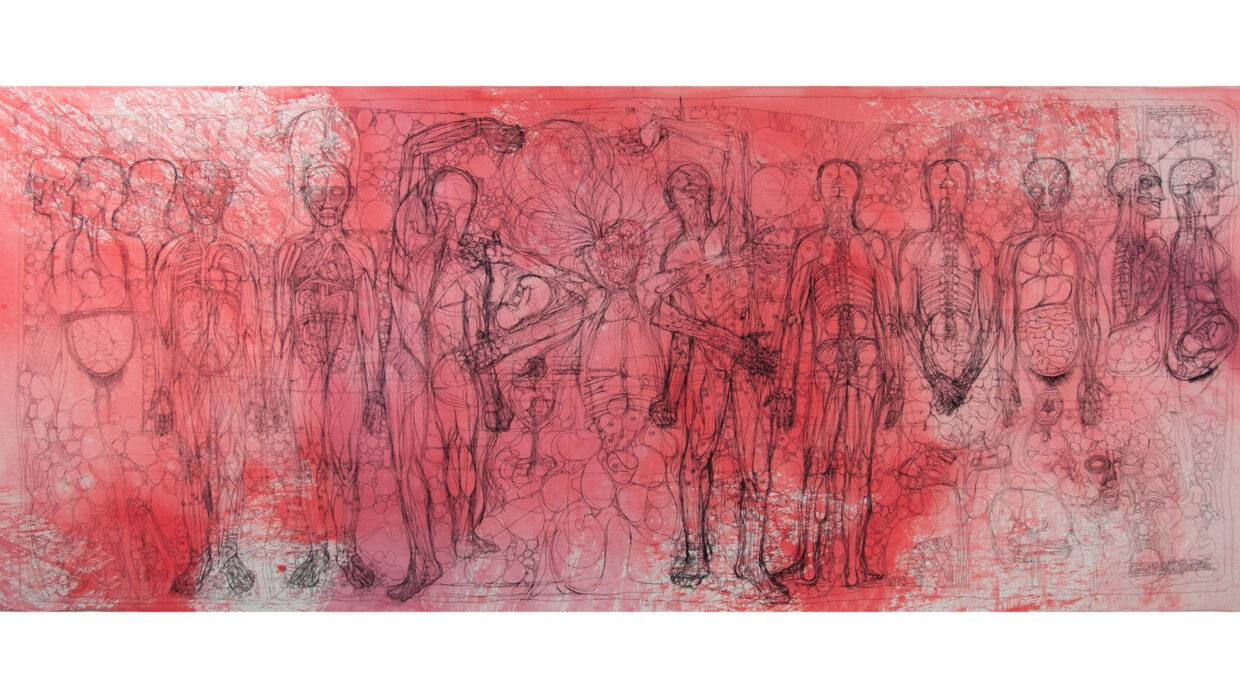
At the forefront of Nitsch’s interpretation of the biblical scene are twelve figures framing a four-armed torso in the centre. The depiction of this central figure is reminiscent of designs of the Vitruvian Man, whose ideal proportions were to be applied by ancient architects to all buildings. Nitsch labelled his drawing with the words: ‘design for an underground city based on the image of the last supper for the action drama the destruction and rebirth of our universe.’ Together with the physical equations on the expansion of the universe also included in the picture, it seems reasonable to interpret the drawing as a desire for analogy, a ‘being the same,’ between humans and the cosmos.
In Nitsch’s ‘Last Supper,’ the human figures are represented only by their outlines, muscles, organs, or skeletons. Some of these figures are embedded in and on designs of fictional spaces. They become further abstracted in the course of the image composition. Human figures, foetuses in the womb and screaming mouths merge with organically shaped spaces to form a sprawling architecture of action. Here, Hermann Nitsch draws on the conceptual vocabulary he used in 1971 in his drawing for the tragedy ‘The Conquest of Jerusalem’. He marks spaces with numbers that cross-reference dramatic events that were to take place in these locations during the course of the action. ‘The Last Supper’ is therefore not to be understood as an isolated individual work, if only because of its visual language. Rather, it is one of the visualisations of the concept of the Orgien Mysterien Theater.
The text that Hermann Nitsch wrote in the year 2000 to accompany his ‘Last Supper’ opens up another level that is relevant to his entire oeuvre. In it, Nitsch explains that his starting point for the work was not the Gospel of John, as was the case with Leonardo da Vinci, for example, in which the washing of feet, the commandment of love and Jesus’ farewell speech take centre stage. He based his work on the texts of the other Gospels that refer to the Eucharist. For Nitsch, this sacrificial ritual was ‘one of the most profound mysteries that religions have ever produced.’
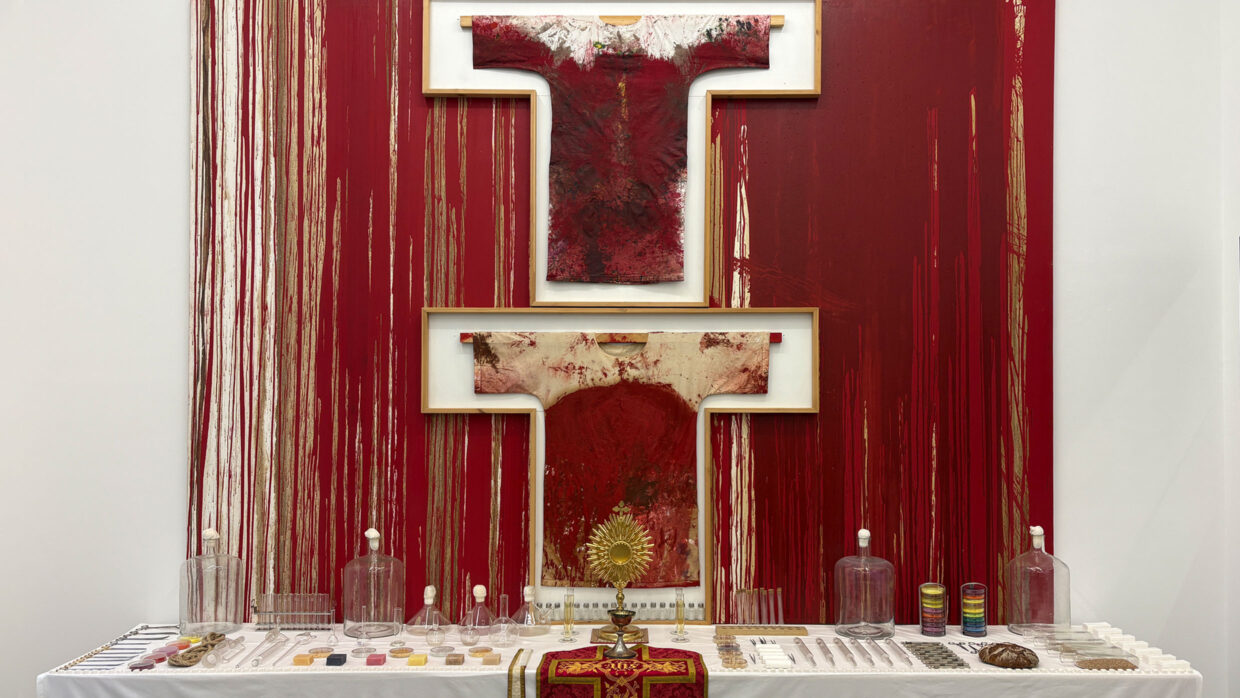
Without being a practising Christian himself, Nitsch was fascinated by Eucharistic cults, their symbolic content and their sensual intensity. Bread and wine, chalices, monstrances, wine and water jugs, communion wafers, folded cloths, bowls and ritual vestments had a powerful effect on him and became an integral part of his installations. These objects stand for themselves as forms, but they also symbolise transubstantiation, in which the substance of bread and wine is transformed into the body of the Saviour without changing its form.
‘god himself embodies the outside world, becomes food, dies within us, experiences his rebirth and resurrection in us as eaten divine substance,’ writes Nitsch. Through this transformation of being, God ultimately becomes perceptible to humans with all their senses. A God who, like the (also four-armed) Hindu deities Vishnu and Shiva, stands for destruction and construction.
In relation to his Orgien Mysterien Theater (Theatre of Orgies and Mysteries), Hermann Nitsch understood the overcoming of language as a form of transubstantiation: a process through which real events can be experienced with all five senses and transformed into direct sensory perception. The separation between the inner world and the outer world is lifted, the difference between transcendence and immanence is eliminated. The participants in the O.M. Theatre perform the essence of the world process, the transformation from death to resurrection, and are drawn deeper into being.
The original design for the exhibited screen print ‘The Last Supper’ by Hermann Nitsch was created between 1976 and 1979 in pencil and ballpoint pen on paper. He drew the motif on a single continuous sheet of paper measuring 152 x 368 cm. Today, this work is part of the Hall Art Collection at Derneburg Castle in Germany. In 1983, the drawing was first published as a silkscreen print on white canvas and blood-stained relic cloths. In 2021, the year before his death, Hermann Nitsch commissioned a second edition. This version (exhibited here) was printed on coloured action painting, transforming ‘The Last Supper’ into a luminous celebration of resurrection.