

Hermann Nitsch 1960–1965
exhibition at the new Wiener Aktionismus Museum
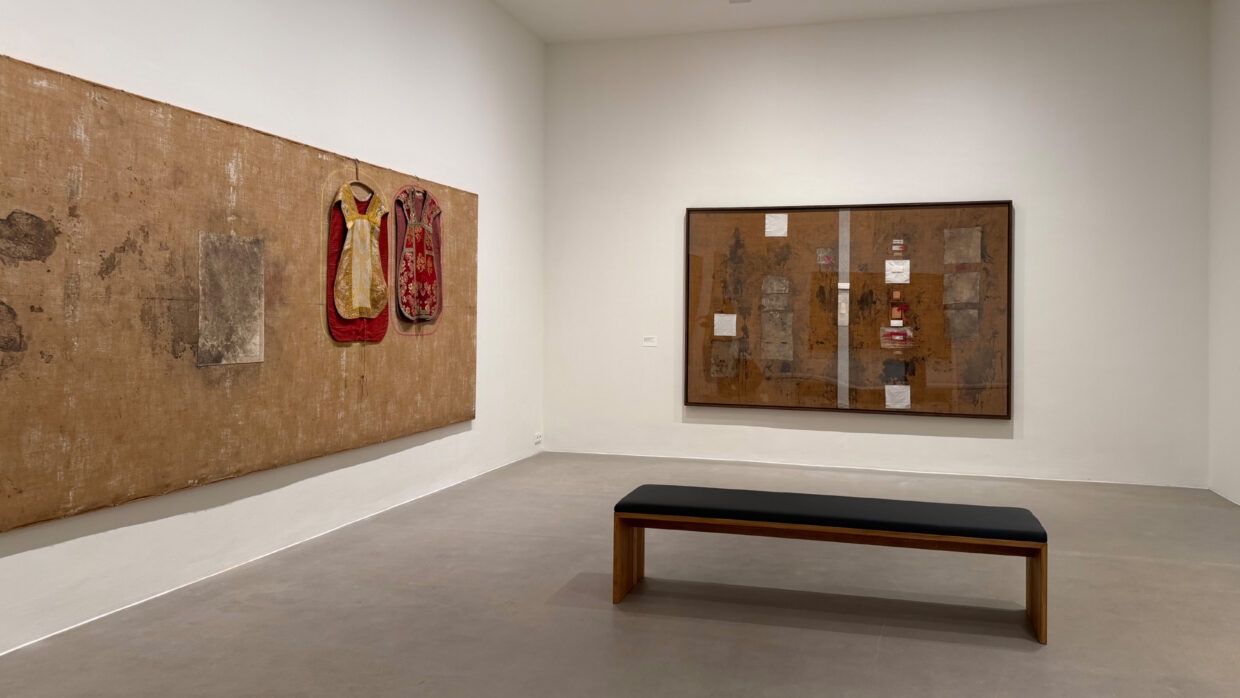
The exhibition HERMANN NITSCH. 1960 to 1965 at the WIENER AKTIONISMUS MUSEUM is dedicated to the late artist’s early work, which ranges from his pouring and dripping paintings to his relic montages, and extends to works created before the 1960s, revealing the transition from technically trained graphic artist to expressive painter. Hermann Nitsch developed a visual, symbolic, and actional language in his painting, in which body, material, and ritual merge. The selected works demonstrate the determination with which Nitsch laid the foundations for his oeuvre, thereby profoundly influencing art history.
“For Nitsch, this opened a path to realizing his own ambition: through the painting process, extreme physical and psychological experiences were to be endured, repressed impulses uncovered and overcome, in order to arrive at a heightened experience of existence. Nitsch poured and splashed paint onto canvases and called the works ‘pouring paintings’.” He lets paint trickle down vertically and calls his results “trickle paintings.” Klaus Albrecht Schröder, Director of the Wiener Aktionismus Museum.
Around 1960, Nitsch worked in the studio of the Vienna Technical Museum under simple conditions with fiberboard and older supports. The first trickle and wax paintings were created. Influenced by Art Informel, Nitsch let the paint trickle slowly from the top edge of the canvas downwards. Materiality, gravity, and time are the form-creating forces. Nitsch also worked with wax, which he poured in layers onto the support, creating dense, tactile surfaces. These early experiments mark the beginning of a style of painting in which the process became more important to Nitsch than the finished picture.
At the end of 1960, Nitsch carried out his first painting action. Paint was poured, sprayed, and applied to the canvas with his entire body. The act of painting was central: color, movement, and material merged into a performative event. This focus on the act of painting Nitsch’s work is situated within the context of international Action Painting, which, since the 1940s, has focused on the creative process of painting. While artists like Markus Prachensky work with dynamically poured, often intensely red paint, and Arnulf Rainer radically transforms existing paintings through overpainting, Nitsch develops a painting practice that centers on real materials and ritualistic actions.
“In his early action paintings (1960–1963), Nitsch attempts to capture the sensual states of arousal triggered by the painting process on the canvas. The more the painting process itself becomes an event, the more clearly Nitsch recognizes the limitations of the picture plane: metaphorical imagery gives way to immediate reality. Gradually, his practice shifts from painterly gesture to actionist action.” Julia Moebus-Puck, Curator of the Exhibition and Director of Collections, Wiener Aktionismus Museum.
In these early works, Nitsch reveals himself as a Symbolist in a fundamental sense. In his relic montages, he applies handkerchiefs, plasters, and menstrual pads, as well as real blood, liturgical objects, and vestments, to canvases. These materials become complex carriers of meaning: they allude to wounds, blood, healing, and purification, and connect physical traces with Christian symbolism. In this way, a pictorial space emerges in which sacrifice, suffering, and transformation become visible.
Nitsch’s visual language developed within the social climate of postwar Austria—a time strongly characterized by repression, silence, and the desire for a new order. Nitsch countered this atmosphere with a radical artistic movement. His actions and painting processes evoke situations of excess that provoke intense physical and emotional reactions. Smells, materials, and physical touch become part of the experience. Excess becomes the means of making repressed feelings visible and tangible. In the radical nature of his actions, Nitsch takes on these suppressed impulses, as it were, vicariously—as an artist who makes society’s repressed affects visible.
“The formal rigor manifested in the clarity of his early works marks a crucial stage in Hermann Nitsch’s artistic development. It forms the structural foundation of his entire later oeuvre. The early paintings and relics demonstrate that Nitsch’s practice was based on order, measure, and compositional control from the very beginning. The calculated arrangement of materials, the precise measurement of distances, and the deliberate reduction of means point to an artistic approach characterized less by a gesture of excess than by conceptual stringency.” Julia Moebus-Puck.
(Text © Wiener Aktionismus Museum)